
The math isn't obvious. Leasing looks cheaper month-to-month but often costs more overall. Buying looks expensive upfront but can pay off faster for the right business. And the "right" answer changes depending on your print volume, growth stage, and whether you want to manage equipment in-house.
This guide breaks down both options clearly — including a side-by-side comparison, real cost benchmarks, and a practical framework for making the call that fits your business.
Key Takeaways
- Leasing preserves working capital with predictable monthly payments and bundled maintenance
- Buying delivers full ownership, no ongoing payments after payoff, and potential Section 179 tax deductions
- Total lease costs often exceed the outright purchase price once a 36–60 month term is complete
- Print volume, growth trajectory, and available capital are the three variables that determine which path fits
- Leasing fits businesses prioritizing cash flow and flexibility; buying suits those optimizing for long-term cost
Leasing vs. Buying a Printer: Quick Comparison
Here's how leasing and buying compare across the dimensions that affect your budget, flexibility, and long-term costs.
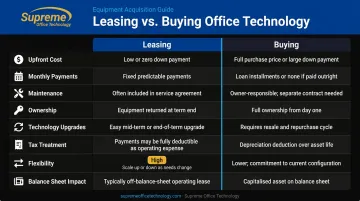
| Dimension | Leasing | Buying |
|---|---|---|
| Upfront cost | Low or none | $1,399–$14,000+ depending on device |
| Monthly payments | Fixed for lease term | None after payoff (or loan payments) |
| Maintenance | Often bundled in monthly fee | Owner's responsibility |
| Ownership | No (unless $1 buyout clause included) | Full ownership from day one |
| Technology upgrades | Swap at end of term | Capital expenditure required |
| Tax treatment | Payments deductible as business rent (if true lease) | Section 179 deduction up to $2.5M in 2025 |
| Flexibility | High — upgrade at term end | Low — stuck with equipment until you sell or replace |
| Balance sheet | Right-of-use asset recognized (ASC 842, leases over 12 months) | Asset on balance sheet |
Understanding Lease Types
Not all leases work the same way. Two structures matter for small businesses:
- Fair Market Value (FMV) lease — You return or buy at market value at term end. Monthly payments are lower, and the IRS generally treats payments as deductible rent if it qualifies as a true lease.
- $1 buyout lease — Structured for ownership from the start. Payments are higher, and the IRS may treat this as a conditional sales contract, meaning payments aren't deductible as rent. Confirm with your accountant.
Standard lease terms run 36–60 months. The lease type you choose directly affects your monthly payment — here's what equipment-only costs look like using publicly available Kyocera NASPO contract data as a verified benchmark:
- Basic A4 mono MFP (Kyocera ECOSYS MA4500ifx, $1,461 purchase price): ~$52/month at 36 months, ~$37/month at 60 months
- Mid-range A3 color MFP (Kyocera ECOSYS M8130cidn, $2,831 purchase price): ~$102/month at 36 months, ~$72/month at 60 months
- High-end A3 color system (Kyocera TASKalfa MZ7500ci, $12,437 purchase price): ~$448/month at 36 months, ~$314/month at 60 months
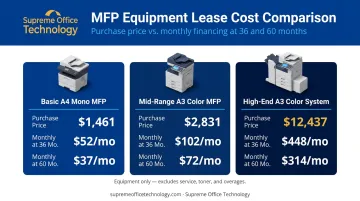
These figures cover equipment only — service agreements, toner, and overage charges will add to your actual monthly spend.
Pros and Cons of Leasing a Printer for Your Small Business
Advantages of Leasing
Preserves working capital. A capable mid-range A3 color MFP costs $2,800+ outright. For startups, branch offices, or businesses prioritizing hiring and marketing, spreading that cost into manageable monthly payments keeps high-quality equipment accessible without depleting cash reserves.
Bundles maintenance into one predictable payment. Most lease agreements include maintenance, repairs, and often toner as part of the monthly fee. This converts unpredictable service expenses into a fixed cost — important for small businesses without dedicated IT staff. Supreme Office Technology provides responsive on-site service as part of lease agreements, minimizing downtime for Connecticut businesses.
Built-in technology refresh. At the end of the term, you move to a newer model rather than staying stuck with aging equipment. This matters most in legal, healthcare, and financial services — industries where security features, scan-to-cloud capabilities, and hard drive data management evolve quickly.
The FTC's digital copier data security guide notes that modern copiers store document data internally, making equipment refresh a legitimate security consideration, not just a convenience.
Lease payments are generally tax-deductible. If your agreement qualifies as a true operating lease (not a conditional sales contract), the IRS allows you to deduct payments as a business rent expense. This is simpler than calculating depreciation schedules. Confirm the structure with your accountant before signing.
Disadvantages of Leasing
Three cost-related disadvantages stand out:
- Higher total cost. Leasing a Kyocera MA4500ifx over 36 months totals roughly $1,895 in equipment-only payments — versus $1,461 to buy outright. That gap widens over longer terms and higher-end devices.
- Contract lock-in. Most leases run 36–60 months, with early termination fees that can require paying off the remaining principal. Overage rates typically run $0.024–$0.070 per color page — 5,000 extra pages at $0.07 adds $350 in a single month.
- No ownership. Unless your lease includes a $1 buyout clause, you return the equipment at term end. The printer never becomes a business asset.
Pros and Cons of Buying a Printer for Your Small Business
Advantages of Buying
Purchasing makes sense for businesses with steady, long-term printing needs. Here's what works in its favor:
- Full ownership once the equipment is paid off, with no ongoing payments. For businesses holding a device five-plus years, total cost of ownership runs lower than leasing the same unit across multiple terms.
- Section 179 tax deduction: For 2025, the IRS allows businesses to deduct up to $2,500,000 in qualifying equipment placed in service during the tax year, phasing out above $4,000,000 in total purchases. Commercial printers and MFPs generally qualify as 5-year property under MACRS. Bonus depreciation rules are also in flux for 2025 — confirm the specifics with a CPA before purchasing.
- No page volume restrictions: Owned equipment has no base allotment, no overage fees, and no usage caps.
Disadvantages of Buying
Significant upfront capital is the biggest barrier. A capable SMB multifunction printer starts around $1,399 for a basic monochrome A4 unit and climbs to $12,437–$14,019 for high-end A3 color systems. For businesses with limited cash reserves, that capital could otherwise fund hiring, inventory, or marketing.
Maintenance responsibility shifts entirely to you without a service contract. Repair costs and downtime become your problem, and finding responsive technicians on short notice can be difficult and expensive. Supreme Office Technology offers service agreements and managed print services for purchased equipment, which can offset this burden — though it's a separate cost to factor into your decision.
Technology can outpace your equipment. A printer bought today may lack the security features, cloud connectivity, or processing speed your business needs in three to four years. That forces another capital expenditure sooner than expected, eroding the cost advantage of buying outright.
Which Option Is Right for Your Small Business?
The If/Then Framework
Choose leasing if:
- You're a startup or growing business with limited upfront capital
- You want maintenance, supplies, and service in one predictable monthly payment
- Your print needs may change as the business grows
- You operate in a regulated industry where current security features and uptime matter
- You prefer leaving capital available for other growth priorities
Choose buying if:
- You have stable, high-volume print needs and plan to use the equipment for 5+ years
- Capital is available and you can take advantage of Section 179 in a profitable year
- You prefer owning a business asset outright with no ongoing payment obligation
- Your print needs are simple and consistent (low risk of needing a technology upgrade)
Print Volume Is the Key Variable
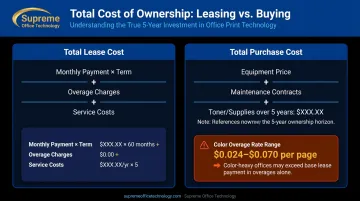
Rather than guessing, calculate your actual total cost of ownership over 36–60 months:
- Total lease cost: Monthly payment × term, plus estimated overage charges and any bundled service costs
- Total purchase cost: Equipment price, plus maintenance contracts and toner/supplies over 5 years
Color mix matters here. Overage rates on color pages can range from $0.024 to $0.070 per page depending on the device and contract. A color-heavy office can easily spend more on overages than on the base lease payment in a given month.
Industry and Business Stage Context
Law firms, medical offices, and financial services businesses in Connecticut frequently benefit from leasing for specific reasons beyond cost:
- Reliable uptime guaranteed through service agreements
- Regular refresh cycles that keep security features current
- No internal IT burden for equipment management
According to the SBA's 2025 Connecticut profile, there are 381,129 small businesses in the state — 99.4% of all Connecticut businesses. By contrast, simpler home-based operations with low, consistent print volume are often better served by outright purchase of a reliable monochrome device.
The Leasing Partner Matters
The quality of your dealer affects the lease experience as much as the contract terms. A local, experienced dealer offers faster service response, personalized guidance, and more flexibility than large national vendors.
Supreme Office Technology has served Connecticut businesses since 1982 and offers a no-obligation office assessment to evaluate your specific print needs: volume analysis, workflow requirements, and which acquisition path makes sense before you commit.
Frequently Asked Questions
How much does it cost to lease a commercial printer?
Using verified public-contract benchmarks, equipment-only monthly costs range from roughly $37–$52/month for a basic mono A4 MFP on a 36–60 month term, to $72–$102/month for a mid-range color A3 device. Bundled maintenance and toner agreements add to that — request a quote based on your actual volume and device class for an accurate number.
Is it cheaper to buy or lease a copier?
Buying costs less over the long term — lease totals on the same device typically exceed the purchase price over a 36–60 month term. Leasing makes more sense short-term and for businesses that value bundled maintenance, predictable cash flow, and the option to upgrade at term end.
Is renting a printer worth it?
Short-term rentals (weeks to months) serve event-based or project-specific needs. Standard leases (36–60 months) suit businesses that want predictable costs, included service, and access to current equipment without a large upfront investment.
What happens at the end of a printer lease?
Typical end-of-lease options include: returning the equipment, renewing the lease (often at a lower rate), or purchasing at fair market value — or for $1 if a buyout clause was included. Provide written notice within the timeframe specified in your lease to avoid automatic renewal at full rates.
Can I negotiate the terms of a printer lease?
Yes — page allowances, overage rates, included supplies, upgrade options, and end-of-lease buyout terms are all negotiable levers worth discussing before signing. Before signing, confirm the buyout formula, overage rate caps, and renewal notice window are explicitly documented in the contract.
What lease term length is best for a small business?
A 36-month term balances reasonable monthly payments with flexibility to upgrade. Businesses expecting rapid growth or technology changes may prefer a 24-month term. Longer terms (48–60 months) lower monthly costs but lock you in — appropriate when your print environment is stable and well-understood.