? — Complete Guide](https://file-host.link/website/supremeofficetechnology-zaif1j/assets/blog-images/5007f0b5-6eb6-4b97-bdf1-78e9d065d7ae/1782913143358057_9eb994ccb2264eef859430f64f4bcc55/360.webp)
Introduction
Picture a Connecticut business owner who set up antivirus software three years ago and hasn't thought about cybersecurity since. It feels handled. It probably isn't.
According to the 2025 Verizon Data Breach Investigations Report, ransomware appeared in 88% of confirmed breaches among small businesses with fewer than 1,000 employees. Meanwhile, CrowdStrike's 2026 Global Threat Report found that 82% of detections were malware-free — meaning signature-based antivirus misses the majority of modern intrusion methods entirely.
That gap is exactly what a managed IT security service provider (MSSP) is built to close. This guide covers what an MSSP is, how it differs from a standard MSP, and what Connecticut businesses should look for when evaluating one.
Key Takeaways
- An MSSP handles cybersecurity monitoring, threat detection, and incident response — separate from general IT support
- MSSPs run 24/7 Security Operations Centers (SOCs); MSPs focus on uptime, not active threat response
- Core services include firewall management, MDR, SIEM monitoring, and compliance reporting
- Ransomware hit 88% of small business breaches in 2025 — continuous monitoring is no longer optional
- Start with a no-pressure security assessment to identify gaps before committing to any service
What Is a Managed IT Security Service Provider?
A managed IT security service provider is a third-party organization that takes over the monitoring, management, and protection of a company's security infrastructure. According to Gartner, managed security services cover management and operational functions tied specifically to security technologies and outcomes — not general IT support.
In practical terms, that means an MSSP handles:
- Network and endpoint monitoring
- Threat detection and incident response
- Firewall and perimeter management
- Vulnerability assessments
- Compliance documentation and reporting
How MSSPs Operate
MSSPs work out of dedicated Security Operations Centers that run around the clock. Threats don't observe business hours, which means client businesses get continuous protection without building or staffing their own security team.
The service model typically comes in two forms:
- Fully managed security — The MSSP handles everything. Best for businesses with no internal security staff or IT team
- Co-managed security — The MSSP supplements an existing internal IT team, filling gaps in coverage, tooling, or expertise. Better for organizations with some security capacity that needs reinforcement
A Brief History
Understanding where MSSPs came from helps explain why the model works the way it does today. The category took shape in the late 1990s as businesses began connecting to the internet at scale and realized their internal teams couldn't keep pace with emerging cyber risks. What started as basic firewall monitoring has grown into a global market that MarketsandMarkets projects will reach $66.83 billion by 2030, up from $39.47 billion in 2025.
Why Businesses Are Turning to Managed IT Security Services
The Cybersecurity Skills Gap
Finding qualified security professionals is difficult. The ISC2 2024 Cybersecurity Workforce Study puts the global workforce gap at 4.8 million unfilled positions, with the U.S. alone needing nearly 265,000 more workers according to NIST's CyberSeek data. For most small and mid-sized businesses in Connecticut, competing for that talent — and affording it — isn't realistic.
An MSSP fills that gap — giving businesses access to a full security operations team without the recruiting cost or timeline.
The Cost of Getting Breached
A single breach carries consequences most SMBs aren't equipped to absorb. IBM's 2025 Cost of a Data Breach Report puts the global average breach cost at $4.44 million. Even if your exposure is a fraction of that figure, the combination of forensics, legal fees, notification costs, regulatory penalties, and reputational damage adds up quickly.
For Connecticut businesses in regulated sectors, the financial exposure grows further. Under the Connecticut Data Privacy Act, violations can carry civil penalties up to $5,000 per violation, and breach notifications must be filed within 60 days of discovery.
The Expanding Attack Surface
Remote work has fundamentally changed what needs to be protected. Gallup's 2024 data shows 52% of remote-capable U.S. employees work hybrid, with another 27% fully remote. Each home network, personal device, and cloud application represents a potential entry point that didn't exist five years ago.
Recent breach data confirms how fast that exposure is growing:
- The 2024 Verizon DBIR reported vulnerability exploitation increased 180% year-over-year
- The human element was a factor in 68% of breaches
- Median time for a user to click a phishing link: under 60 seconds
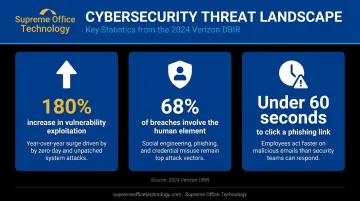
Protecting a distributed workforce requires tools and expertise that go well beyond traditional perimeter security.
Compliance Pressure and Evolving Threats
Regulated industries — healthcare (HIPAA), payments (PCI DSS), legal, and education — face ongoing documentation, monitoring, and audit requirements that don't pause between reviews. MSSPs are built to maintain the continuous logging, access controls, and evidence trails these frameworks require.
At the same time, threats have grown more sophisticated. CrowdStrike's 2026 report documents an 89% increase in attacks from AI-enabled adversaries. Ransomware, credential-based intrusions, and supply chain compromises now require expert human triage — not just automated tools.
Core Services an MSSP Provides
24/7 Security Monitoring and Threat Detection
Continuous monitoring is the foundation. An MSSP watches networks, endpoints, and systems around the clock, flagging suspicious activity the moment it appears. An internal IT generalist with other responsibilities can't provide the same coverage, especially outside business hours when many attacks occur.
Managed Firewall and Network Perimeter Management
Firewalls require active management, not one-time configuration. MSSPs continuously update firewall rules to reflect new threat intelligence, monitor for unauthorized access attempts, and adjust policies as the network changes. A static firewall configuration left untouched for months becomes progressively less effective as the threat landscape shifts.
Vulnerability Scanning and Penetration Testing
These are related but distinct services:
- Vulnerability scanning — Automated, recurring identification of known weaknesses across systems and software. Think of it as a regular health check
- Penetration testing — Human-led simulation of real-world attacks to test whether those vulnerabilities are actually exploitable. NIST defines it as testing where evaluators mimic real-world attacks to find ways around existing security controls
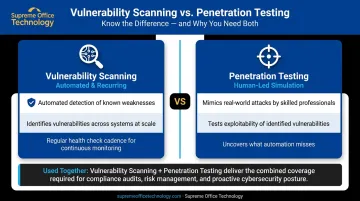
Used together, these services catch what automated tools alone would miss — and give you documented evidence of what was tested and when, which matters for compliance audits.
Managed Detection and Response (MDR)
MDR goes beyond monitoring. Gartner describes it as human-led, turnkey SOC functions that deliver threat disruption and containment — not just alerting. When an MSSP detects a threat, MDR means analysts actively investigate and contain it, reducing the window between detection and damage.
That gap matters: IBM's Cost of a Data Breach report consistently shows that faster containment directly reduces breach costs — often by hundreds of thousands of dollars.
Compliance Monitoring and Reporting
MSSPs track whether security controls meet applicable regulations, generate audit-ready documentation, and alert clients when system changes could create compliance gaps.
For organizations under HIPAA, PCI DSS, or state-level data privacy laws, this ongoing support is often what drives the decision to bring in an MSSP in the first place — not just security, but the audit trail that proves it.
Key Benefits of Partnering With a Managed IT Security Service Provider
Cost Efficiency vs. Building In-House
Staffing a security operations center internally requires hiring analysts, purchasing tools, maintaining infrastructure, and covering 24/7 shifts. For most Connecticut SMBs, that cost is prohibitive.
MSSPs offer predictable, subscription-based pricing that converts a large capital investment into a manageable operational expense. The choice comes down to a monthly service fee versus funding a full security team, toolset, and infrastructure independently.
Supreme Office Technology has served Connecticut businesses since 1982, offering managed IT services scaled to SMB realities — local, responsive support without the cost of standing up internal security capacity from scratch.
Access to Expert Knowledge and Advanced Tools
MSSPs spread the cost of threat intelligence platforms, detection software, and security expertise across their entire client base. A single SMB couldn't justify those investments independently. Through an MSSP, businesses access that same technology and expertise at a fraction of the standalone cost.
That access typically includes:
- Threat intelligence platforms updated in real time
- Endpoint detection and response (EDR) tools
- Security information and event management (SIEM) systems
- Dedicated analysts with experience across industries
Always-On Protection and Faster Incident Response
Speed matters during a security incident. Research consistently shows that breach costs rise the longer containment is delayed. Because MSSPs operate continuous SOCs with dedicated analysts, they detect and respond to threats faster than a part-time internal team could — which directly limits the financial and operational impact of any incident.
MSP vs. MSSP: Understanding the Difference
The terms MSP and MSSP are often used interchangeably — but they describe fundamentally different services.
| MSP | MSSP | |
|---|---|---|
| Primary focus | IT operations, uptime, helpdesk | Cybersecurity monitoring, detection, response |
| Operations center | Network Operations Center (NOC) | Security Operations Center (SOC) |
| Security role | May offer basic security as one service among many | Security is the core and only focus |
| Best for | Day-to-day IT reliability | Threat monitoring and incident response |
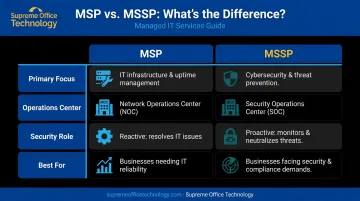
An MSP keeps your systems running. An MSSP does something different: it monitors for threats, investigates alerts, and coordinates incident response. Many businesses need both — and some MSPs have expanded to include security capabilities, which blurs the line in practice.
The practical question to ask yourself: Is your biggest gap IT reliability, or security? If it's reliability, start with an MSP. If threat monitoring, compliance, or incident response is the concern, you need dedicated security operations.
How to Choose the Right Managed IT Security Service Provider
Key Evaluation Criteria
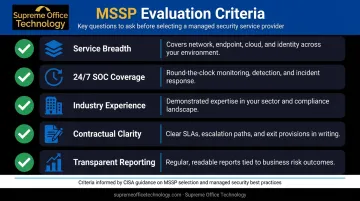
When comparing providers, focus on:
- Service breadth — Confirm the MSSP covers what your risk profile actually requires: MDR, SIEM, vulnerability scanning, and compliance support
- 24/7 SOC coverage — Verify that monitoring is truly continuous, not limited to business hours
- Industry experience — Look for proven work with businesses in your sector, particularly regulated industries like healthcare or legal
- Contractual clarity — CISA recommends agreements that explicitly define security roles, require MFA for all accounts accessing your environment, and retain critical logs for at least six months
- Transparent reporting — Can they provide clear, regular reporting you can act on — not just dashboards?
Questions to Ask Before Signing
- How quickly do you respond to a confirmed threat, and how is that guaranteed in the contract?
- How do you handle compliance reporting for HIPAA or PCI DSS?
- Do you offer co-managed options if we have internal IT staff?
- What does onboarding look like, and how long until we're fully covered?
- How are your provider accounts secured — do you use MFA and separate credentials per client?
That last question carries real weight: CISA has documented cases where attackers targeted managed service providers specifically to reach multiple client networks through a single breach. How a provider secures its own accounts is a direct indicator of how seriously it takes yours.
Starting With a Security Assessment
Before committing to any provider, start with an assessment. Supreme Office Technology offers a no-obligation IT/Network Assessment for Connecticut businesses. It maps your current security posture, surfaces gaps, and helps clarify what level of support you actually need. Request one at supremeofficetechnology.com/request-assessment or call (203) 239-6511.
Frequently Asked Questions
What are managed IT security services?
Managed IT security services are outsourced cybersecurity functions — including network monitoring, threat detection, firewall management, and compliance reporting delivered by a third-party MSSP on a continuous, subscription basis. The provider handles security operations so your internal team doesn't have to.
What is the difference between an MSP and an MSSP?
MSPs handle general IT management: infrastructure, helpdesk, software support, and uptime. MSSPs focus exclusively on cybersecurity, operating dedicated SOCs for 24/7 threat monitoring and incident response. Some MSPs now offer integrated security services, but a dedicated MSSP brings deeper security expertise and purpose-built tooling.
What services does a managed IT security service provider typically offer?
Core services include firewall management, intrusion detection, vulnerability scanning, managed detection and response (MDR), SIEM monitoring, endpoint protection, and compliance reporting. The exact mix varies by provider and the scope of your engagement.
How much do managed IT security services cost?
Pricing depends on service scope, number of monitored endpoints and users, compliance requirements, and whether 24/7 SOC coverage is included. No reliable public benchmark exists for SMB pricing. Request a customized quote based on your environment and risk profile.
What should I look for when choosing a managed IT security service provider?
Prioritize 24/7 availability, industry-specific experience, clearly defined SLAs, credential separation between clients, and transparent reporting. CISA's guidance on managed service provider contracts is a useful reference for contract requirements.
Is a managed IT security service provider right for small businesses?
MSSPs are particularly well-suited for SMBs, which rarely have the budget or headcount to build internal security teams. Managed security gives smaller organizations access to 24/7 threat monitoring and incident response at a predictable monthly cost, without staffing a full SOC.