
The per-user model looks clean on paper. In practice, base fees, hardware, add-ons, taxes, and contract terms combine to create a total cost that can run 30–40% higher than the headline number.
This guide breaks down what hosted VoIP actually costs per user, every line item you should budget for, and what separates an accurate budget from an expensive guess.
Key Takeaways
- Hosted VoIP typically costs $15–$50 per user per month, with most businesses landing in the $20–$35 range
- Hardware, taxes, add-ons, and regulatory fees routinely add 20–35% on top of the base rate
- Annual contracts reduce per-user costs by 15–33% compared to month-to-month billing
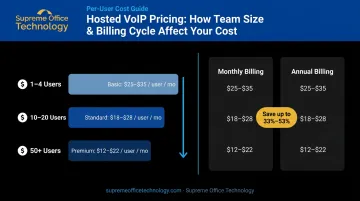
- Smaller teams pay more per seat; volume discounts kick in at 10, 20, and 50+ users
- Matching your plan tier to actual usage — not assumed needs — is the fastest way to cut unnecessary VoIP spend
How Much Does Hosted VoIP Cost Per User?
There is no single market price for hosted VoIP. The per-user rate depends on your plan tier, team size, provider, and which features are bundled versus billed as extras. Choosing the wrong tier means either surprise overage bills or paying for capabilities nobody uses.
Here's how the three tiers typically break down:
Basic Plans: $15–$25/User/Month
Entry-level plans generally land in the $15–$25 per user per month range when billed annually. Nextiva's Core plan starts at $15, RingCentral starts at $20, and Vonage's Mobile tier runs $19.99 for small teams.
What's typically included:
- Unlimited domestic calling
- Basic voicemail and caller ID
- Call forwarding
- Softphone app (desktop and mobile)
- One local phone number
Best for: Small teams with straightforward calling needs, or businesses testing VoIP before committing to a full rollout.
Standard Plans: $25–$40/User/Month
Step up to the mid-tier and you get collaboration and documentation tools that basic plans skip entirely. Nextiva Engage is $25 annually, RingCentral Advanced sits at $25, and Vonage Premium runs $24.99–$29.99 depending on line count.
What's typically added at this level:
- Call recording and voicemail transcription
- Auto-attendant and multi-level call routing
- Video conferencing
- Basic analytics and reporting
- CRM integrations
- Larger toll-free minute pools
Best for: Growing businesses handling moderate call volume across departments, teams needing mobile and desktop softphone flexibility, and industries like legal, healthcare, or real estate where call documentation matters.
Premium / Enterprise Plans: $40–$75+/User/Month
At the top tier, pricing reflects enterprise-grade capabilities. Nextiva Scale runs $75 per user annually; Microsoft 365 E5 (with Teams Phone) reaches $54.75 per user monthly.
What's typically included:
- Advanced AI-powered call analytics and reporting
- Omnichannel support (voice, chat, SMS, email)
- Deep CRM and business app integrations
- Dedicated account management and priority support
- Custom call routing and contact center features
- Compliance tools for regulated industries
Best for: Larger organizations, contact centers, and businesses with complex routing needs. Most small-to-mid-size businesses don't need this tier. The feature gap between standard and premium rarely justifies the added cost unless you're running high call volumes or need contact center functionality.
Key Factors That Affect Hosted VoIP Cost Per User
The price on a provider's pricing page is shaped by several variables. Miss these, and your budget will be off from day one.
Number of Users
Hosted VoIP pricing is volume-sensitive. Vonage's published pricing shows this clearly:
| Plan | 1–4 Lines | 20–99 Lines | Savings |
|---|---|---|---|
| Mobile | $19.99 | $14.99 | 25% |
| Premium | $29.99 | $24.99 | 17% |
| Advanced | $39.99 | $34.99 | 13% |
RingCentral states annual billing can save up to 33% depending on team size. If you have fewer than 10 users, expect to pay closer to the top of each tier's range.
Contract Length
Month-to-month plans offer flexibility at a real cost. Nextiva's Core plan illustrates the gap plainly: $15/user annually vs. $23/user monthly — a 53% premium for the flexibility of month-to-month billing. Vonage advertises 30% off with annual contracts.
Multi-year deals can push savings further but carry termination risk if your needs change. Weigh that trade-off before committing.
Features Included vs. Add-On
A low base rate can climb quickly once features are priced separately. RingCentral's published add-on pricing shows how fast this adds up:
- AI Receptionist: $39/month
- Conversational Intelligence: $60/month
- Call Queues Booster: $35/month
- Business SMS Booster: $25/month
Before selecting a plan, list every feature your team actually uses and confirm whether it's bundled or billed separately.
Hardware Decisions
Going software-only (softphone apps only) eliminates upfront hardware costs entirely. If your team needs physical desk phones, budget accordingly:
| Category | Price Range |
|---|---|
| Basic IP desk phone (e.g., Yealink SIP-T31P) | $69–$120 |
| Mid-range IP phone (e.g., Poly Edge E320) | $126–$269 |
| Wired headset | $41–$111 |
| Wireless headset | $115–$359 |
Multiply these by your user count and hardware costs can easily reach $2,500–$5,000+ for a 20-person team.
Internet Infrastructure
Nextiva recommends a minimum of 100 kbps upload and download per concurrent VoIP call. For a 15-person office where 10 people might be on calls simultaneously, that's 1 Mbps dedicated to voice — before accounting for everything else running on your network.
Businesses with inadequate internet connections may need to upgrade their service, adding a recurring infrastructure cost that belongs in your budget from the start.
Full Hosted VoIP Cost Breakdown: What You're Actually Paying For
Businesses that budget only for the monthly per-user fee consistently encounter first-bill surprises. Here's how the real cost picture breaks down across one-time, recurring, and periodic categories.
One-Time Costs
| Cost Item | Typical Range |
|---|---|
| Setup / onboarding fee | $0–$500 |
| Number porting (per number) | Free–$30 |
| IP desk phones (per user) | $69–$270+ |
| Headsets (if needed) | $41–$359 per user |
For context: on-premises PBX installation can exceed $10,000 including $1,000+ in technical labor, while hosted VoIP setup typically runs $0–$500. That upfront cost gap is one of the strongest arguments for cloud-hosted systems.
Recurring Monthly Costs
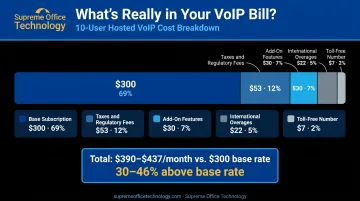
Here's what a sample monthly bill might look like for a 10-user business on a standard plan at $30/user:
- Base subscription (10 users × $30): $300
- One toll-free number: $5–$10
- International calling overages: $15–$30
- Add-on features (voicemail transcription, etc.): $20–$40
- Taxes and regulatory fees (~15%): $50–$57
- Total estimated monthly bill: $390–$437
That's 30–46% above the base subscription line — before hardware is factored in.
Taxes and Regulatory Fees
The ~15% estimate in the sample bill above is a midpoint — the actual burden varies by location. Government-mandated fees include federal Universal Service Fund (USF) contributions, E911 fees, and state and local telecom taxes. Vonage's 2026 pricing guide puts the total range at 5%–20% of the VoIP bill.
Connecticut businesses face an additional layer: the state's E911 surcharge runs $0.74/month per line for standard accounts, with lower per-line rates for larger accounts. Small per seat, but real and recurring — and rarely mentioned in headline pricing.
Periodic / Scaling Costs
These appear as the business grows or changes:
- Adding users mid-contract may trigger repricing
- Upgrading plan tiers increases the per-user rate across all seats
- Hardware refresh cycles (phones typically every 4–7 years)
- Early termination fees if switching providers before contract end
Ask any prospective provider to walk through each of these scenarios before you sign. A contract that looks affordable today can shift significantly when you add a department or upgrade tiers.
Budget vs. Premium Hosted VoIP: What's the Real Difference?
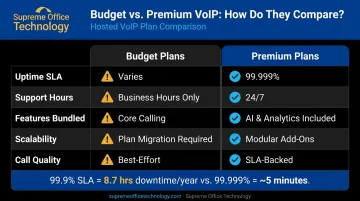
Budget and premium plans can look similar on a feature list. The differences show up in reliability, support responsiveness, and what happens when something goes wrong.
| Dimension | Budget Plans | Premium Plans |
|---|---|---|
| Uptime SLA | Varies — not always published | 99.999% (five-nines) — Zoom, Intermedia, Microsoft, Dialpad |
| Support hours | Business hours or limited | 24/7 phone, chat, and email |
| Features bundled | Core calling only | Recording, analytics, AI, integrations |
| Scalability | May require plan change or migration | Modular add-ons without disruption |
| Call quality assurance | Best-effort | SLA-backed with dedicated bandwidth |
Budget plans work well for businesses with light call traffic or simple routing needs. Premium plans justify their cost when downtime or missed calls directly affect revenue.
A Connecticut law firm managing client intake or a medical practice coordinating patient scheduling can't afford dropped calls or a support queue that takes 48 hours to resolve. The math makes it concrete: a 99.9% uptime guarantee allows roughly 8.7 hours of downtime per year. A 99.999% guarantee cuts that to about 5 minutes.
How to Estimate the Right Hosted VoIP Budget for Your Business
Use this framework to build a realistic number before you talk to any provider.
Step-by-step for a 15-user business on a mid-tier plan at $30/user:
- Base subscription: 15 users × $30 = $450/month
- Hardware (if needed): 15 phones × $150 average = $2,250 one-time
- Add-ons you'll actually use: Call recording + analytics = ~$30/month
- Taxes and fees (estimate 15%): $72/month
- Number porting (one-time): $0–$150 for 5 numbers
- Monthly ongoing total: ~$552/month ($6,624/year)
That's 23% above the base subscription line — before hardware amortization.
Four Budgeting Mistakes to Avoid
- Base fee tunnel vision: Ignoring add-ons, taxes, and regulatory fees inflates your expectations and quietly shrinks your usable budget.
- Skipping the feature audit: Run a feature audit before committing to a tier. You may be paying for AI tools your team will never open.
- Trusting uptime percentages at face value: A 99.9% SLA reads fine on paper — until you realize it permits 8+ hours of downtime per year.
- Underestimating hardware costs: For teams moving from legacy desk phones, the hardware line is often the biggest first-year surprise.
Getting an accurate quote means sharing your team size, call volume, existing infrastructure, and feature priorities with a provider. Supreme Office Technology provides no-obligation office technology assessments for Connecticut businesses, helping you identify the right hosted VoIP setup based on your actual usage — not an upsell. Reach them at (203) 239-6511 or info@supremeofficetechnology.com.
Frequently Asked Questions
How much does hosted VoIP cost per user?
Hosted VoIP typically runs $15–$50 per user per month, with most businesses landing in the $20–$35 range on a standard plan billed annually. Once hardware, taxes, and add-on features are included, total per-user cost typically runs 20–35% higher than the base subscription.
What is included in a per-user hosted VoIP plan?
Included features vary by tier:
- Entry-level: Unlimited domestic calling, voicemail, caller ID, and a softphone app
- Mid-tier: Call recording, auto-attendant, analytics, video conferencing, and basic CRM integrations
- Premium: AI features, omnichannel support, and advanced reporting
Is hosted VoIP cheaper than a traditional PBX system?
Generally yes — especially on upfront costs. Hosted setup typically runs $0–$500 vs. $10,000+ for on-premises PBX installation. RingCentral cites customer examples of 30% savings on overall phone system costs after migrating from legacy systems.
Does contract length affect the per-user cost?
Annual contracts deliver meaningfully lower per-user rates — Vonage offers 30% off, RingCentral up to 33%. Multi-year agreements can reduce costs further but reduce flexibility if your team size or needs shift significantly.
Are there hidden fees with hosted VoIP?
The most common unexpected charges include:
- Taxes and regulatory fees: 5–20% added to your monthly bill
- Number porting: $0–$30 per number
- Add-on features: Anything not bundled in your base plan
- Early termination fees: Applicable on multi-year contracts
How many users do I need for hosted VoIP to be cost-effective?
Hosted VoIP works for teams of any size — Vonage publishes pricing for 1–4 lines, and most providers have no meaningful minimum. Volume discounts make it increasingly cost-effective as teams grow. The right benchmark is comparing your all-in VoIP cost against what you're currently spending on legacy phone lines, not against a user-count threshold.