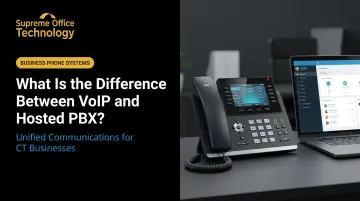
Choosing the wrong solution can mean paying for features you'll never use, underestimating setup costs, or locking into a system that can't scale as your business grows. Understanding exactly what each term means — and how they relate to each other — makes the decision far simpler.
This article gives you plain-English definitions of both, a side-by-side comparison, and practical guidance on which option fits different business situations.
Key Takeaways
- VoIP is a technology — a protocol that transmits voice calls as digital data over the internet instead of traditional phone lines
- With Hosted PBX, a third-party provider manages your entire cloud phone system — built on VoIP, but with full call routing and administration included
- All hosted PBX systems use VoIP, but not all VoIP setups include the call management capabilities of a hosted PBX
- Hosted PBX suits businesses that want advanced call management without hiring telecom staff
- Standalone VoIP is the better fit for businesses adding SIP trunking to an existing on-premise PBX, not replacing it
VoIP vs. Hosted PBX: At a Glance
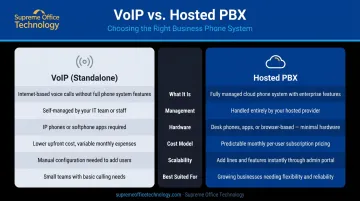
Here's a side-by-side breakdown of how VoIP and Hosted PBX compare across the factors that matter most to your business.
| Category | VoIP (Standalone) | Hosted PBX |
|---|---|---|
| What it is | Internet-based calling protocol | Fully managed cloud phone system |
| Management | Managed in-house by IT staff | Managed by the provider |
| Hardware required | May require on-site PBX servers | IP phones or softphone apps only |
| Cost model | Higher upfront hardware costs | Predictable monthly per-user fee |
| Scalability | Hardware upgrades often needed | Add/remove users via web portal instantly |
| Best suited for | IT-staffed orgs with existing PBX | SMBs, remote teams, multi-location businesses |
What Is VoIP?
According to the FCC, VoIP (Voice over Internet Protocol) is a technology that allows voice calls using a broadband internet connection instead of a regular analog phone line. It's a communication standard, not a product or a service.
Here's how it works: a device captures your voice, converts it into compressed digital data packets, sends those packets over the internet, and reassembles them into audio on the receiving end — all within milliseconds.
How Businesses Use VoIP
VoIP isn't one-size-fits-all. Businesses can implement it in several ways:
- VoIP adapters — connect existing analog desk phones to a VoIP service
- IP phones — purpose-built desk phones that connect directly over the internet
- Softphone apps — software on computers, tablets, or smartphones that handles calls
- On-premise IP-PBX systems — a full phone system server installed and managed on-site
When Standalone VoIP Makes Sense
Pure VoIP — without a full hosted PBX system — works best for specific situations:
- Businesses that already own functioning on-premise PBX hardware and want to reduce landline costs through SIP trunking
- Very small operations or solo professionals using a simple VoIP app
- Organizations with dedicated IT staff capable of managing an on-site IP-PBX
One important caveat: Cisco distinguishes VoIP from IP telephony by noting that VoIP is the transport protocol, while IP telephony uses VoIP standards to build a full phone system with routing, voicemail, and contact center features. Without the PBX layer, standalone VoIP has no multi-line routing, auto attendants, or company directories — which is why most businesses eventually need a hosted PBX on top of it.
What Is a Hosted PBX Phone System?
A PBX (Private Branch Exchange) is the call management system that routes calls between extensions, handles voicemail, manages auto attendants, and connects internal users to outside lines. A hosted PBX delivers all of that through the cloud — the provider owns and operates all the server infrastructure, and your business accesses it over the internet.
No server room. No dedicated telecom hardware on-site. Just phones and an internet connection.
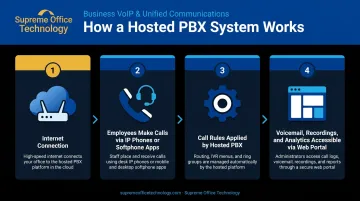
How It Works
- Your business connects to the provider's cloud servers over the internet
- Employees make and receive calls on IP desk phones or softphone apps
- The hosted PBX applies your call rules — time-of-day routing, ring groups, IVR menus
- Voicemail, call recordings, and analytics are stored and accessible through a web portal
Core Features Hosted PBX Adds Over Bare VoIP
These are enterprise-grade capabilities that standalone VoIP simply doesn't include:
- Auto attendant / IVR menus
- Call queues and ring groups
- Extension dialing between employees
- Call recording and voicemail-to-email
- Call analytics and reporting
- Conferencing bridges
Grand View Research estimated the global hosted PBX market at $11.20 billion in 2023, projecting growth to $31.07 billion by 2030 at a 16.7% CAGR — driven largely by SMBs moving away from hardware-dependent systems.
Who Benefits Most from Hosted PBX
That growth tracks with who's actually adopting it:
- SMBs without in-house telecom expertise
- Professional services firms in healthcare, legal, and financial sectors needing reliable, compliant communications
- Multi-location organizations that need a unified phone system across sites
- Remote or hybrid teams who need to make and receive calls from any device on their business number
Supreme Office Technology has helped businesses in New Haven, Waterbury, and Middletown move to hosted phone systems — giving them enterprise call management without the cost or complexity of on-site hardware.
VoIP vs. Hosted PBX: Key Differences Explained
Every hosted PBX uses VoIP to carry calls — but VoIP alone doesn't include the management layer a real business phone system requires. Think of VoIP as the engine: necessary, but not the whole vehicle. Hosted PBX is the complete, road-ready system built on top of it.
Cost Structure
| System Type | Cost Drivers |
|---|---|
| On-premise IP-PBX | PBX server/appliance, IP phones, licenses, installation, IT labor, ongoing maintenance |
| Hosted PBX | Monthly per-user subscription — PCMag reports tested business VoIP pricing ranges from $10 to $65 per user per month depending on features and provider |
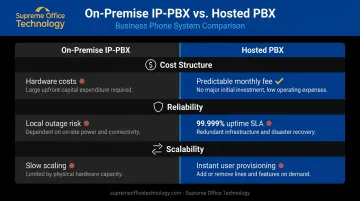
On-premise setups carry significant capital expenditure upfront, plus ongoing IT maintenance costs. Hosted PBX shifts that to a predictable operating expense with minimal upfront investment.
Control and Customization
On-premise VoIP/IP-PBX gives businesses full control over their telephony infrastructure — appealing when call flows are complex and an internal IT team has the expertise to manage them. Hosted PBX trades some of that granular control for simplicity, faster deployment, and reduced IT overhead. For most SMBs, that's a worthwhile trade.
Reliability and Business Continuity
On-premise systems are vulnerable to local disruptions: power failures, hardware failure, physical damage to your office. Hosted PBX runs on geographically distributed data centers — major providers like RingCentral and Webex publish 99.999% uptime SLAs for their cloud calling platforms, translating to less than six minutes of downtime per year.
More practically: if your office loses power, a hosted PBX can automatically reroute calls to employee mobile phones. An on-premise system goes dark entirely.
For businesses in sectors where a missed call means lost revenue or a compliance issue — healthcare, legal, financial services — that built-in failover matters.
Scalability
Scaling on-premise VoIP typically means purchasing additional hardware, obtaining licenses, and scheduling IT work. With hosted PBX, adding a user means logging into a web portal and provisioning the account — a process that takes minutes, not weeks.
Which Phone System Is Right for Your Business?
The decision comes down to your existing infrastructure, internal IT capacity, and growth trajectory.
Choose standalone VoIP or SIP trunking if:
- Your business already owns functioning PBX hardware in good condition
- You have dedicated IT staff with telecom experience
- Your primary goal is reducing per-minute call costs without replacing the system
Choose hosted PBX if:
- You're starting fresh or replacing aging equipment
- You're adding remote or hybrid workers
- You want enterprise phone features without managing telecom infrastructure
- Predictable monthly costs matter more than upfront control
The Middle-Ground Option: SIP Trunking as a Bridge
Some businesses use SIP trunking as an interim step — keeping their on-premise PBX while routing calls over VoIP to reduce costs — before eventually migrating to a full hosted PBX. This phased approach makes sense for organizations with recent hardware investments they're not ready to write off.
Talk to a Local Connecticut Specialist
For Connecticut businesses unsure which direction aligns with their current setup and growth plans, Supreme Office Technology offers no-obligation office assessments to identify the right communication solution — whether that's a hosted phone system, a SIP trunking bridge, or a phased upgrade plan. Reach out by phone at (203) 239-6511 or email info@supremeofficetechnology.com for a personalized recommendation.
Frequently Asked Questions
What is the difference between VoIP and hosted PBX?
VoIP is the internet-based protocol that transmits voice calls as digital data — it's a technology standard, not a product. Hosted PBX is a complete, cloud-managed phone system built on top of VoIP, delivering the routing, features, and management a business actually uses day to day.
What is a hosted PBX phone system?
A hosted PBX is a fully cloud-based Private Branch Exchange managed by a third-party provider. It gives businesses enterprise phone features — call routing, auto attendant, voicemail, extensions, call recording — without owning or maintaining any on-site PBX hardware.
Can VoIP work without a hosted PBX?
Yes. VoIP can function as a simple internet calling protocol through apps or IP phones without a hosted PBX layer. Without the PBX, however, the business won't have centralized call management features like auto attendants, ring groups, or extension dialing.
Is hosted PBX the same as cloud PBX?
Yes, for most practical purposes. Both terms describe a provider-managed phone system delivered over the internet, and for most business decisions the terms are interchangeable.
What is the difference between hosted PBX and SIP trunking?
SIP trunking connects an existing on-premise PBX to the internet for VoIP calling while keeping the hardware in place. Hosted PBX replaces that on-premise hardware entirely with a cloud-based system managed by the provider, which is a fundamentally different approach.
Do I need special hardware to use a hosted PBX?
Minimal hardware is needed — typically internet-connected IP desk phones or softphone apps on computers and mobile devices. There's no need for on-site PBX servers, dedicated wiring, or telecom equipment rooms.