Managed IT services offer a practical way out. Rather than staffing every IT function internally or reacting to crises as they arise, agencies can outsource ongoing IT operations, monitoring, and support to a specialized provider—freeing staff to focus on serving constituents instead of troubleshooting servers.
This article covers the core benefits government agencies gain from managed IT: measurable cost savings, stronger cybersecurity, built-in compliance support, and access to skilled resources that would otherwise be out of reach.
Key Takeaways
- Managed IT converts unpredictable capital expenditures into fixed, budgetable monthly costs
- Government agencies access enterprise-grade security tools without the cost of full-time specialist hires
- Proactive monitoring reduces downtime and keeps citizen-facing services running
- Compliance with FISMA, CJIS, and HIPAA is built directly into service delivery
- Local provider experience and public-sector familiarity matter more than size alone
Why Government IT Is Uniquely Challenging
Government agencies—especially local and municipal bodies—operate under constraints that private businesses simply don't face. Fixed annual appropriations, public accountability requirements, and rigid budget structures make it nearly impossible to reallocate funds quickly when an IT emergency hits.
The Threat Volume Is Real
The numbers tell a clear story. According to the Center for Internet Security's MS-ISAC, over 40,000 potential cyberattacks targeted state, local, tribal, and territorial communities in 2024 alone. Ransomware hit 117 U.S. government entities that same year—up from 95 in 2023—according to Emsisoft's 2024 ransomware report.
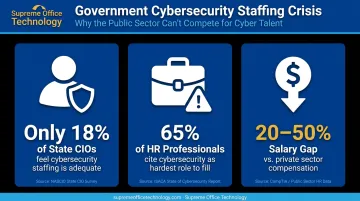
Despite this, staffing hasn't kept pace with the threat:
- Only 18% of state CIOs felt their cybersecurity staffing was adequate (NASCIO)
- 65% of state and local HR professionals identified cybersecurity as one of their hardest roles to fill (MissionSquare Research Institute)
- State cyber salaries lag private-sector equivalents by 20% to 50%, making competitive hiring nearly impossible for most municipal agencies
Legacy Systems and Expanding Demands
Many agencies are still running infrastructure built for a different era. A NASCIO survey found that 48% of state respondents reported at least half of their applications needed modernization—yet IT budgets are largely consumed by maintaining what already exists.
That maintenance burden leaves little room for progress. Citizen expectations for digital services have escalated sharply, with online portals, remote work capabilities, and cloud adoption now treated as baseline requirements—all expected from agencies working with the same headcount and budgets they had years ago.
Managed IT services offer a direct path to closing that gap: predictable costs, on-demand expertise, and scalable support that fixed government staffing models can't easily replicate.
How Managed IT Services Reduce Costs for Government
The financial case for managed IT in government isn't just about cutting costs—it's about changing how costs behave.
From Unpredictable CapEx to Predictable OpEx
Government agencies must budget months in advance. Emergency server failures, unplanned hardware replacements, and reactive security incidents don't fit neatly into that model. Managed IT converts those unpredictable capital expenditures into a consistent monthly operational expense—one that finance offices can plan around.
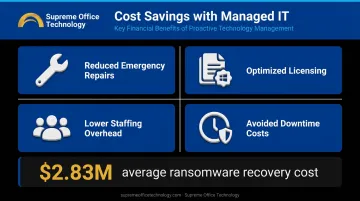
The savings come from multiple directions:
- Reduced emergency repair costs — proactive monitoring catches failures before they become crises
- Optimized licensing — MSPs identify redundant or underused software across departments
- Lower staffing overhead — routine monitoring and maintenance no longer require dedicated in-house headcount
- Avoided downtime costs — for state and local governments hit by ransomware, mean recovery costs reached $2.83 million in 2024, according to Sophos research, more than double the prior year's figure
The Hidden Cost of Reactive IT
Every hour a system is offline translates directly to lost staff productivity and delayed services to residents. A permit office that can't access its database, a public health department unable to pull records, a 311 system that's down—these are measurable failures of public service with real costs attached.
Proactive monitoring prevents most of these incidents before they occur. And when internal IT staff stop firefighting daily issues, that capacity can shift toward higher-value projects:
- Digitizing paper records and archives
- Improving resident-facing portals and online services
- Supporting new service lines without adding headcount
Cybersecurity and Compliance: Critical for Government Agencies
Government organizations are high-value targets. They hold sensitive citizen data—tax records, health information, emergency services data, and law enforcement records—often stored on older systems with known vulnerabilities. According to Sophos, 98% of ransomware attacks against state and local government organizations resulted in data encryption, with a median ransom payment of $2.2 million.
What a Quality MSP Provides
A well-structured managed IT agreement gives agencies access to security capabilities they couldn't build or staff independently:
- 24/7 threat monitoring with automated alerting and escalation
- Endpoint protection across all devices, including remote and field equipment
- Intrusion detection and prevention systems
- Patch management to close known vulnerabilities before attackers exploit them
- Incident response planning developed and tested before a crisis hits—not assembled under pressure
- Data backup and disaster recovery protocols designed for government continuity requirements
Sophos found that only 8% of government ransomware victims recovered within one week, while 59% took more than one month to fully recover. A tested recovery plan directly improves those numbers.
Navigating the Compliance Landscape
Government agencies operate under a set of compliance frameworks that require ongoing attention, not just annual audits:
| Framework | Who It Applies To | What It Requires |
|---|---|---|
| FISMA | Federal agencies and federally funded programs | Information security standards per NIST guidelines |
| CJIS | Law enforcement and justice agencies | Security controls for criminal justice information |
| HIPAA | Government health programs and agencies handling health data | Administrative, physical, and technical safeguards for electronic health records |
With a capable MSP, audit trails, access controls, and compliance documentation are built into day-to-day operations. When an audit arrives, the evidence is already there.
Types of Managed IT Services Available to Government
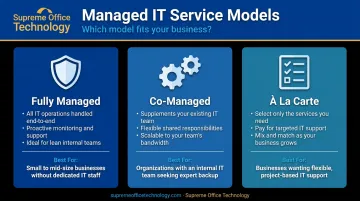
There's no single managed IT model that fits every agency. Most providers offer three primary structures:
Service Model Options
- Fully managed — The MSP handles all IT operations: infrastructure, security, help desk, and strategic planning. Best fit for agencies with little to no internal IT staff
- Co-managed — The provider supplements an existing internal team, filling gaps in areas like cybersecurity monitoring or patch management. Works well for agencies that need specialized reinforcement without full outsourcing
- À la carte — Agencies select specific services—help desk support, backup and recovery, compliance reporting—without committing to a full arrangement. A low-commitment entry point for agencies testing the model
Most agencies begin with specific pain points—cybersecurity gaps, help desk overload, compliance documentation—and expand the engagement over time as trust and ROI are established.
Core Service Categories
The service model determines who manages what, but the underlying scope stays consistent. Most managed IT agreements for government cover:
- Network infrastructure monitoring and management
- Cloud services administration
- Endpoint security across devices
- IT help desk and user support
- Data backup and disaster recovery
- Compliance reporting and audit documentation
- Document management and workflow automation, including records digitization
Agencies with large volumes of paper-based records—permits, case files, public health documentation—can bundle digitization and workflow automation into the same managed agreement. That means fewer vendors to manage and a single point of accountability for both IT and document operations.
How to Choose the Right Managed IT Partner for Government
Not every MSP is equipped to serve government clients. The compliance requirements, procurement expectations, and accountability standards are different from commercial work—and the consequences of a poor fit are higher.
Key Evaluation Criteria
When assessing providers, government agencies should look for:
- Demonstrated public-sector experience, including familiarity with government procurement processes
- Compliance expertise across relevant frameworks (FISMA, CJIS, HIPAA, state-specific requirements)
- 24/7 support availability with documented response commitments
- Transparent, predictable pricing that maps to government budget cycles
- Scalability to grow with the agency's evolving needs
- Local presence for on-site support and relationship continuity
That last point deserves more emphasis than it usually gets. A large national MSP may offer broad capabilities, but often routes government clients through centralized support tiers with rotating account managers and no local accountability. A provider physically present in the community responds faster, understands local context, and builds the kind of ongoing relationship government procurement actually relies on.
Supreme Office Technology has served Connecticut businesses and public-sector organizations—including public school districts—for over 40 years. The company combines local responsiveness with enterprise-level tools through its partnership with Konica Minolta's managed services division.
For government and public-sector clients, that means NIST compliance support, document workflow solutions for state and federal agencies, and on-site assessments conducted at the client's location.
Start With a Technology Assessment
Narrowing down a provider is easier once you know what you're working with. Before committing to any service model, request a no-obligation technology assessment. It establishes a documented baseline of current IT costs, security gaps, and compliance posture—so any future managed IT engagement can be measured against real numbers rather than assumptions. That baseline also helps agencies make the case internally when presenting to budget committees or elected officials.
Frequently Asked Questions
What are managed IT services for government agencies?
Managed IT services involve outsourcing ongoing IT management—monitoring, security, maintenance, and help desk support—to a specialized provider. Government staff focus on their public-service mission while the MSP handles IT infrastructure and keeps systems running reliably.
How can managed IT services save money for local government?
Managed IT replaces unpredictable repair and emergency staffing costs with a fixed monthly fee. Proactive monitoring reduces costly downtime, and agencies no longer need to hire full-time specialists for every IT function—resulting in measurable budget predictability across fiscal years.
What compliance regulations do government IT systems need to meet?
The most common frameworks are FISMA for federal and federally funded programs, CJIS for law enforcement and justice agencies, and HIPAA where health data is involved. A qualified MSP builds compliance into ongoing operations, maintaining audit trails and access controls continuously rather than as a one-time exercise.
How do managed IT services improve cybersecurity for local government?
MSPs provide 24/7 threat monitoring, layered endpoint protection, patch management, and tested incident response protocols. Most small agencies cannot staff or afford these capabilities internally, making an MSP engagement one of the most practical ways to build security capabilities that match current threat levels.
What is the difference between fully managed and co-managed IT services?
Fully managed means the MSP handles all IT operations. Co-managed means the provider works alongside an existing internal IT team to fill specific skill gaps or take on defined functions. Both models can be cost-effective. The right choice depends on the agency's size, existing capabilities, and where understaffing creates the most operational risk.
How do government agencies choose the right managed IT provider?
Prioritize providers with documented public-sector experience, relevant compliance expertise, local support availability, and pricing that fits government budget cycles. Start with a technology assessment to identify gaps before committing to a service model.